I've spent more than 25 years working with businesses across Canada and the United States in ecommerce, web development, and digital marketing.
During that time, I've watched retail change dramatically.
But few shifts have been as important as the one we're experiencing today: the line between physical retail and ecommerce is disappearing.
For Toronto retailers, that's particularly important.
Toronto has always been an incredible retail city. From independent shops along Queen Street West to luxury retailers in Yorkville, neighbourhood businesses on the Danforth, and major shopping destinations throughout the GTA, retail is deeply embedded in the city's economy and culture.
But today's Toronto retailer isn't competing only with the store across the street.
You're competing with businesses across Canada, Amazon, large international retailers, direct-to-consumer brands, marketplaces, and increasingly sophisticated Shopify stores.
At the same time, there's a major opportunity.
Statistics Canada reported that Canadian retail businesses generated $73.7 billion in ecommerce revenue in 2024, an increase of 9% from the previous year.
And ecommerce continues to represent billions of dollars in Canadian retail spending every month.
The message for Toronto retailers is clear:
Ecommerce is no longer an optional side project. It's becoming a fundamental part of running a modern retail business.
But I also don't believe the future is about abandoning physical retail.
The biggest opportunity is often combining the strengths of your physical store with the reach, convenience, data, and scalability of ecommerce.
Here's how I recommend approaching that transition.
Why Toronto Retailers Should Take Ecommerce Seriously
One mistake retailers sometimes make is thinking about ecommerce as simply another place to list their products.
It's much bigger than that.
A strong ecommerce operation can fundamentally change the economics and potential reach of a retail business.
1. Your Market Becomes Much Larger
A physical store has a geographic limitation.
Even if you have a fantastic location in Toronto, most of your customers will naturally come from Toronto and the surrounding GTA.
Ecommerce changes that.
Suddenly, a Toronto retailer can sell to customers in:
- Vancouver
- Calgary
- Montreal
- Ottawa
- New York
- Chicago
- Los Angeles
- And potentially markets around the world
Your storefront might be in Toronto.
Your customer doesn't have to be.
That's particularly powerful for retailers selling distinctive products that aren't easily available everywhere.
2. Customers Expect Convenience
Consumers increasingly expect businesses to be available when and where they want to shop.
Sometimes that's inside your physical store.
Sometimes it's at 11:30 p.m. while they're sitting on their couch.
Sometimes they discover you through Google.
Sometimes Instagram.
Sometimes an email.
Sometimes they visit your store, look at a product, and purchase it online three days later.
The modern customer journey is rarely linear.
That's why I encourage retailers to stop thinking about:
"Physical retail versus ecommerce."
Instead, think about:
"How can customers buy from us however they prefer?"
3. Ecommerce Gives You Valuable Customer Data
One of the most powerful aspects of ecommerce is the amount of information it can provide about customer behaviour.
With the right analytics setup, you can understand:
- Which products customers view most
- Which products they search for
- Where customers come from
- Which marketing channels generate sales
- Which products are frequently purchased together
- Where customers abandon the buying process
- How frequently customers return
- Average order value
- Customer lifetime value
- Conversion rate
- Repeat purchase rate
Physical retailers have traditionally had much less visibility into this behaviour.
That data can influence much more than your website.
It can help inform:
- Merchandising
- Inventory
- Promotions
- Product development
- Advertising
- Email marketing
- Store displays
- Pricing
- Customer retention
In other words, ecommerce can make your entire retail business smarter.
4. Your Store Can Sell 24/7
Your Toronto storefront may close at 6 p.m.
Your ecommerce store doesn't.
That's one of the simplest but most powerful advantages of selling online.
Your website becomes another salesperson—one that can:
- Introduce your company
- Explain your products
- Answer common questions
- Recommend related products
- Collect email subscribers
- Process payments
- Generate orders
And it can do that 24 hours a day.
That's why I encourage retailers to think of their ecommerce website as more than a website.
It's a digital retail location.
Don't Close the Store: Connect the Store
When ecommerce first became mainstream, there was a lot of discussion about whether online shopping would replace physical stores.
I think that's the wrong way to look at the future of retail.
For many Toronto businesses, physical stores remain incredibly valuable.
They provide something ecommerce can't fully replicate:
- Human interaction
- Immediate product access
- Product demonstrations
- Physical product inspection
- Local community presence
- Personal service
- Brand experiences
The opportunity is to connect physical and digital retail.
For example, you might allow customers to:
- Buy online and pick up in store
- Check store inventory online
- Order an unavailable size online from inside the store
- Return online purchases to your physical location
- Join your loyalty program online or in store
- Receive email recommendations after visiting
- Purchase products online that they previously saw in person
That's omnichannel retail.
And for businesses with existing physical locations, it can be a significant competitive advantage.
An online-only competitor doesn't have your Toronto storefront.
Use it.
How I Recommend Toronto Retailers Launch Ecommerce
Launching an ecommerce store involves much more than choosing a website template and uploading products.
Before you start building, you need a strategy.
Here's the approach I recommend.
1. Define the Role Ecommerce Will Play
Start by answering a fundamental question:
What do you want ecommerce to accomplish for your business?
Your answer could be:
- Generate additional revenue
- Expand outside Toronto
- Reach customers across Canada
- Enter the U.S. market
- Support your physical locations
- Improve customer convenience
- Generate repeat purchases
- Build a customer database
- Test new products
- Eventually become your primary sales channel
Different goals require different strategies.
For example, if your goal is supporting your Toronto store, features such as local pickup and store inventory become extremely important.
If your goal is selling throughout Canada, shipping logistics become more important.
If your goal is entering the United States, you'll need to think carefully about shipping, duties, returns, currency, and cross-border customer expectations.
Technology should follow strategy—not the other way around.
2. Choose the Right Ecommerce Platform
For many small and mid-sized Canadian retailers, Shopify will naturally be one of the first platforms to consider.
And there's a nice Canadian connection: Shopify was founded in Ottawa.
But that's not the main reason I recommend considering it.
The more important question is whether the platform fits your business.
Depending on your requirements, options may include:
- Shopify
- Shopify Plus
- WooCommerce
- Adobe Commerce
- BigCommerce
- Custom ecommerce solutions
When evaluating platforms, consider:
- Number of products
- Product complexity
- Inventory management
- POS integration
- Payment processing
- Shipping requirements
- International selling
- B2B requirements
- App integrations
- Marketing capabilities
- Scalability
- Total cost of ownership
Don't simply choose the platform with the longest feature list.
Choose the platform your business can realistically operate, maintain, and grow with.
For many Toronto retailers, Shopify offers a strong balance between ease of management and ecommerce capability.
3. Build Your Website Around How Customers Shop
A beautiful ecommerce website isn't necessarily a successful ecommerce website.
I've seen plenty of attractive stores that were frustrating to shop.
Your design needs to help customers move through a simple process:
Discover → Browse → Evaluate → Trust → Purchase
That means paying close attention to:
- Navigation
- Search
- Category structure
- Filtering
- Product photography
- Product information
- Reviews
- Shipping information
- Returns
- Calls to action
- Cart experience
- Checkout
And don't forget mobile.
Your customers aren't necessarily sitting behind laptops.
They're shopping from phones.
Your store should be designed accordingly.
Think Like a Customer
One exercise I recommend is giving someone unfamiliar with your website a simple task.
For example:
"Find a black dining chair under $300 that can be delivered to Toronto."
Then watch them.
Don't help.
Where do they hesitate?
What do they click?
What confuses them?
What information do they look for?
Those moments of hesitation are often where your biggest conversion opportunities exist.
4. Create Product Pages That Actually Sell
For many retailers transitioning online, this is one of the biggest adjustments.
Inside your physical store, a salesperson can answer questions.
Online, your product page has to do much of that work.
Customers can't pick up the product.
They can't feel it.
They can't examine it from every angle.
They can't immediately ask an employee a question.
Your product page has to compensate.
Strong product pages should typically include:
- High-quality photography
- Multiple product angles
- Lifestyle photography
- Detailed descriptions
- Benefits
- Specifications
- Dimensions
- Materials
- Colour information
- What's included
- Shipping information
- Delivery expectations
- Return policies
- Warranty information
- Reviews
- FAQs
For more complicated or expensive products, consider adding:
- Video demonstrations
- Buying guides
- Comparison charts
- Installation information
- Financing options
- Compatibility tools
- downloadable specifications
The more expensive the product, the more questions customers generally need answered before they're comfortable purchasing.
Your product page should reduce uncertainty.
5. Solve Shipping Before You Start Advertising
Shipping is one of the most underestimated challenges in Canadian ecommerce.
Canada is enormous.
Shipping something from Toronto to Mississauga is one thing.
Shipping the same product to Vancouver, Halifax, or Yellowknife is another.
Before aggressively marketing your store, determine:
- Where you'll ship
- Which carriers you'll use
- Shipping rates
- Free-shipping thresholds
- Delivery estimates
- Packaging requirements
- Oversized-product policies
- Remote-location surcharges
- Return shipping
- International shipping
- Duties and taxes
Be transparent.
Unexpected costs during checkout are one of the fastest ways to lose a customer who was otherwise ready to purchase.
Whenever possible, tell customers what to expect before checkout.
6. Offer the Payment Methods Customers Expect
Checkout should feel easy and familiar.
Depending on your platform and market, that could mean supporting:
- Major credit cards
- Shop Pay
- Apple Pay
- Google Pay
- PayPal
- Buy now, pay later options
For higher-ticket products, financing can be particularly important.
The objective isn't to offer every payment method imaginable.
It's to eliminate unnecessary barriers between:
"I want this."
and:
"I bought it."
7. Build an Ecommerce Marketing Engine
Launching your website isn't the finish line.
It's the starting line.
One of the biggest misconceptions I encounter is:
"Once the website launches, people will find us."
Usually, they won't.
You need a customer acquisition strategy.
That might include:
- Google Ads
- Google Shopping
- Meta advertising
- TikTok
- Search engine optimization
- Content marketing
- Email marketing
- SMS marketing
- Influencer partnerships
- Affiliate marketing
- Local SEO
- Partnerships
But don't try everything simultaneously.
Identify where your customers spend time and where they're most likely to demonstrate buying intent.
Don't Forget Email
If I were advising a Toronto retailer launching ecommerce, email marketing would be high on my priority list.
Why?
Because customer acquisition can be expensive.
Once you've paid to acquire a customer, you want the ability to communicate with them again.
At minimum, consider setting up automated email flows for:
- Welcome emails
- Abandoned carts
- Abandoned checkout
- Post-purchase communication
- Product education
- Review requests
- Cross-sells
- Win-back campaigns
Your goal shouldn't simply be to generate an order.
It should be to create a customer who purchases repeatedly.
8. Use Your Toronto Location as a Competitive Advantage
Going online doesn't mean hiding your local identity.
Quite the opposite.
Your Toronto roots can differentiate you.
If appropriate for your brand, highlight:
- Your Toronto story
- Your physical location
- Your team
- Your neighbourhood
- Local pickup
- Local delivery
- Toronto events
- Community involvement
- Canadian ownership
People like buying from real businesses.
A physical Toronto presence can help establish credibility, especially when you're competing against unfamiliar online-only brands.
Your local reputation can become an ecommerce trust signal.
9. Build for Canada First, Then Think Bigger
Selling throughout Canada sounds straightforward, but there are important considerations.
Your website needs to handle:
- Canadian dollars
- Provincial taxes
- Shipping across provinces
- Canadian addresses
- Potential bilingual requirements
- Returns
- Privacy requirements
Then, once the Canadian operation is working well, you can consider international expansion.
For many Toronto retailers, the United States represents the obvious next opportunity because of its enormous consumer market and geographic proximity.
But don't underestimate the complexity.
Cross-border ecommerce can introduce:
- Currency conversion
- Duties
- Customs
- Brokerage fees
- Longer shipping times
- More complicated returns
- Different customer expectations
Expand intentionally.
Get the economics right before chasing the revenue.
Common Ecommerce Mistakes I See Retailers Make
After years of working with ecommerce businesses, I've noticed that many problems aren't caused by technology.
They're caused by strategy.
Here are several mistakes I'd avoid.
Mistake #1: Spending Too Much on the Website Before Proving Demand
You don't necessarily need an enormous custom ecommerce build to start selling online.
Launch something strong.
Learn.
Improve it.
Then invest based on actual customer behaviour.
Mistake #2: Uploading Manufacturer Product Descriptions
If 50 retailers sell the same product using exactly the same copy, why should Google—or a customer—consider your page different?
Create useful original content.
Answer customer questions.
Explain the product better than competitors do.
Mistake #3: Ignoring Photography
Online customers buy with their eyes.
Photography isn't decoration.
It's part of the sales process.
Mistake #4: Launching Without Analytics
Install proper tracking before launch.
You need to understand:
- Where customers come from
- What they do
- What they buy
- Where they leave
- Which marketing generates revenue
Otherwise, you're making decisions based on guesses.
Mistake #5: Measuring Revenue Instead of Profit
A $100,000 ecommerce month sounds great.
But what did it cost to generate?
After advertising, shipping subsidies, payment processing, discounts, returns, product costs, and operating expenses, how much did you actually make?
Track profitability.
Revenue can make you feel successful.
Profit keeps you in business.
The Numbers Show Why Ecommerce Matters
Canadian ecommerce isn't a small niche anymore.
Statistics Canada reported that Canadian retailers generated approximately $73.7 billion in ecommerce operating revenue in 2024, up 9% from the previous year.
More recently, Canadian retail ecommerce sales reached approximately $5.0 billion in May 2026 alone, representing about 6.8% of total retail trade for the month.
Those figures also don't tell the whole story.
Statistics Canada's retail ecommerce figures specifically track online sales made by Canadian-based retailers and exclude purchases Canadians make from foreign-based retailers.
In other words, Canadian consumers' total online spending reaches beyond the domestic ecommerce numbers.
For Toronto retailers, this creates both an opportunity and a warning.
The opportunity is obvious:
There are billions of dollars being spent online.
The warning is equally important:
If you're not competing for those customers online, somebody else is.
A Simple Ecommerce Roadmap for Toronto Retailers
If I were helping an established Toronto retailer move online today, I wouldn't try to do everything at once.
I'd approach it in phases.
Phase 1: Foundation
Focus on:
- Ecommerce strategy
- Platform selection
- Product catalogue
- Inventory
- Photography
- Product content
- Shipping
- Payments
- Analytics
Phase 2: Launch
Build:
- Homepage
- Category pages
- Product pages
- Search
- Filtering
- Cart
- Checkout
- Mobile experience
- Email capture
- Essential automated emails
Phase 3: Customer Acquisition
Start testing:
- Google Shopping
- Google Search
- Meta advertising
- SEO
- Content marketing
- Email marketing
Measure what generates profitable customers.
Phase 4: Conversion Optimization
Once meaningful traffic arrives, improve:
- Conversion rate
- Product pages
- Navigation
- Search
- Mobile UX
- Cart experience
- Average order value
- Checkout completion
Phase 5: Retention
Focus on:
- Repeat purchases
- Email marketing
- Loyalty
- Product recommendations
- Cross-selling
- Customer segmentation
- Win-back campaigns
Phase 6: Expansion
Once the model works, consider:
- New product categories
- New Canadian markets
- U.S. expansion
- Wholesale/B2B
- Marketplaces
- Additional retail locations
That's a much healthier approach than trying to build the "perfect" ecommerce business on day one.
Toronto Retailers Already Have an Advantage
One thing I always remind established retailers is that you're not necessarily starting from zero.
If you've operated a Toronto store successfully for years, you may already have assets that many ecommerce startups would love to have:
- Existing customers
- Brand recognition
- Supplier relationships
- Product knowledge
- Inventory
- Customer service experience
- A physical location
- Local reputation
- Real-world product knowledge
The challenge is translating those advantages into digital experiences.
Your ecommerce competitor may understand Facebook Ads better than you.
But you may understand the customer and product significantly better than they do.
That's valuable.
Combine that knowledge with strong ecommerce execution, and you can build a formidable business.
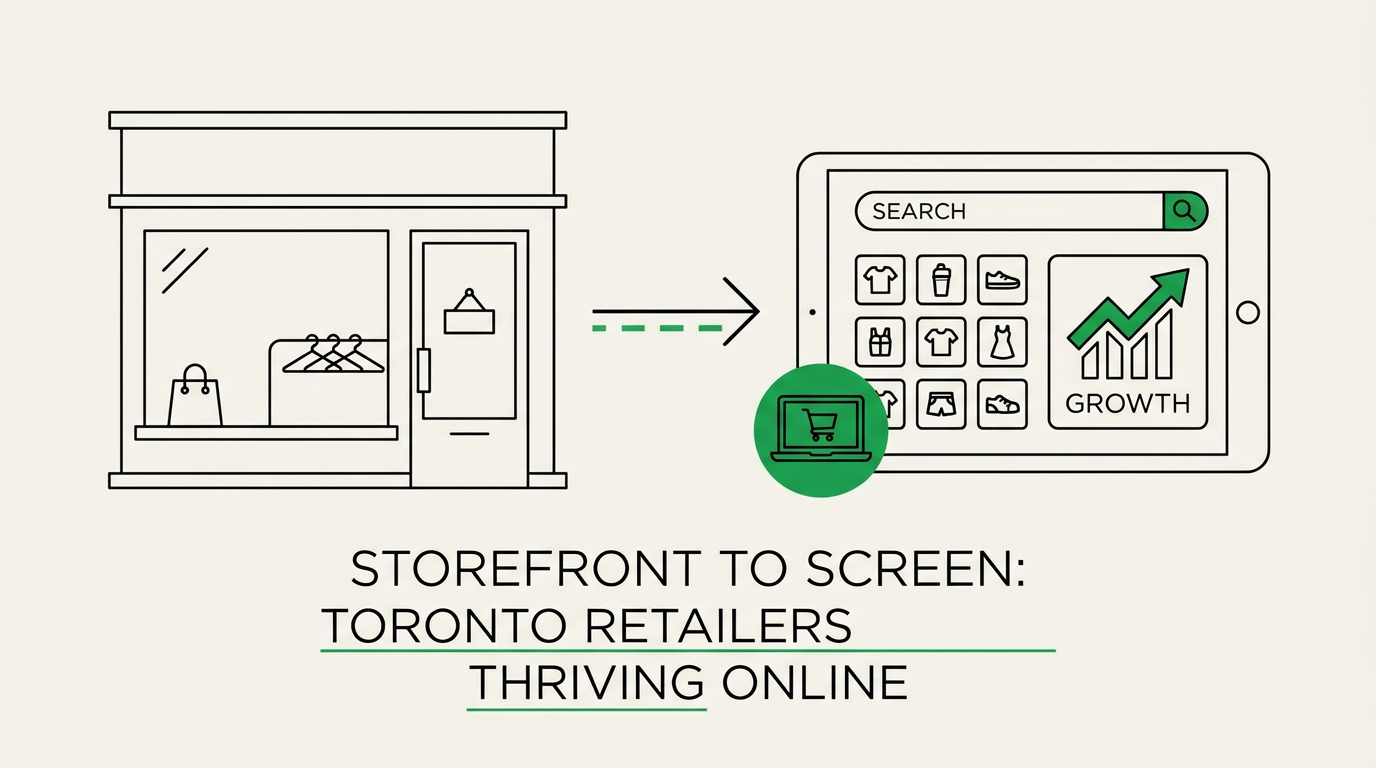
Don't Think Storefront or Screen
After more than 25 years working with businesses across Canada and the United States, I don't believe the future of retail is simply "online."
And I don't believe physical retail is disappearing.
I believe the strongest retailers will learn how to combine both.
Your physical store can create:
Experience. Trust. Community. Human connection.
Your ecommerce store can create:
Convenience. Reach. Data. Scalability.
Together, they're much more powerful.
So if you're a Toronto retailer considering ecommerce, don't think about replacing your storefront.
Think about extending it.
Your physical store might serve customers within a few kilometres.
Your ecommerce store can potentially serve customers across Canada—and eventually around the world.
The storefront isn't disappearing.
It's getting bigger.